
There's a pattern we see repeatedly at MedTech Impact Partners, and it costs companies months of timeline and millions in enterprise value.
A company develops a genuinely novel device — an AI-based SaMD, a first-in-class wearable, a technology creating an entirely new category. The team builds a 510(k) strategy around the closest predicate they can find. The predicate argument is tenuous, everyone quietly knows it, and when FDA pushes back, the company arrives at the De Novo pathway the worst possible way: as a last resort, underprepared and underresourced.
Here's the reframe that separates the companies that win: De Novo is not a detour. For truly novel technology, it is the destination.
The advantage almost everyone underprices
A successful De Novo classification does two things at once. It authorizes your device for marketing — and it creates a brand-new regulatory classification, with Special Controls, built around your device.
Read that again from a competitive standpoint. Your device becomes the de facto predicate for the category. Every competitor that follows must file a 510(k) citing your device and clearing your Special Controls — controls you helped shape around your own architecture. That is a structural moat, written into the regulatory framework itself, that persists long after your initial authorization.
For an early-stage company, that's not just a regulatory outcome. It's a fundraising asset. "We own the regulatory category" is a very different investor conversation than "we cleared on a borrowed predicate."
For a large manufacturer, it's a portfolio question: if your team is defaulting to a stretched 510(k) on a novel product line, you may be trading away category ownership for speed you won't actually realize once FDA challenges the predicate.
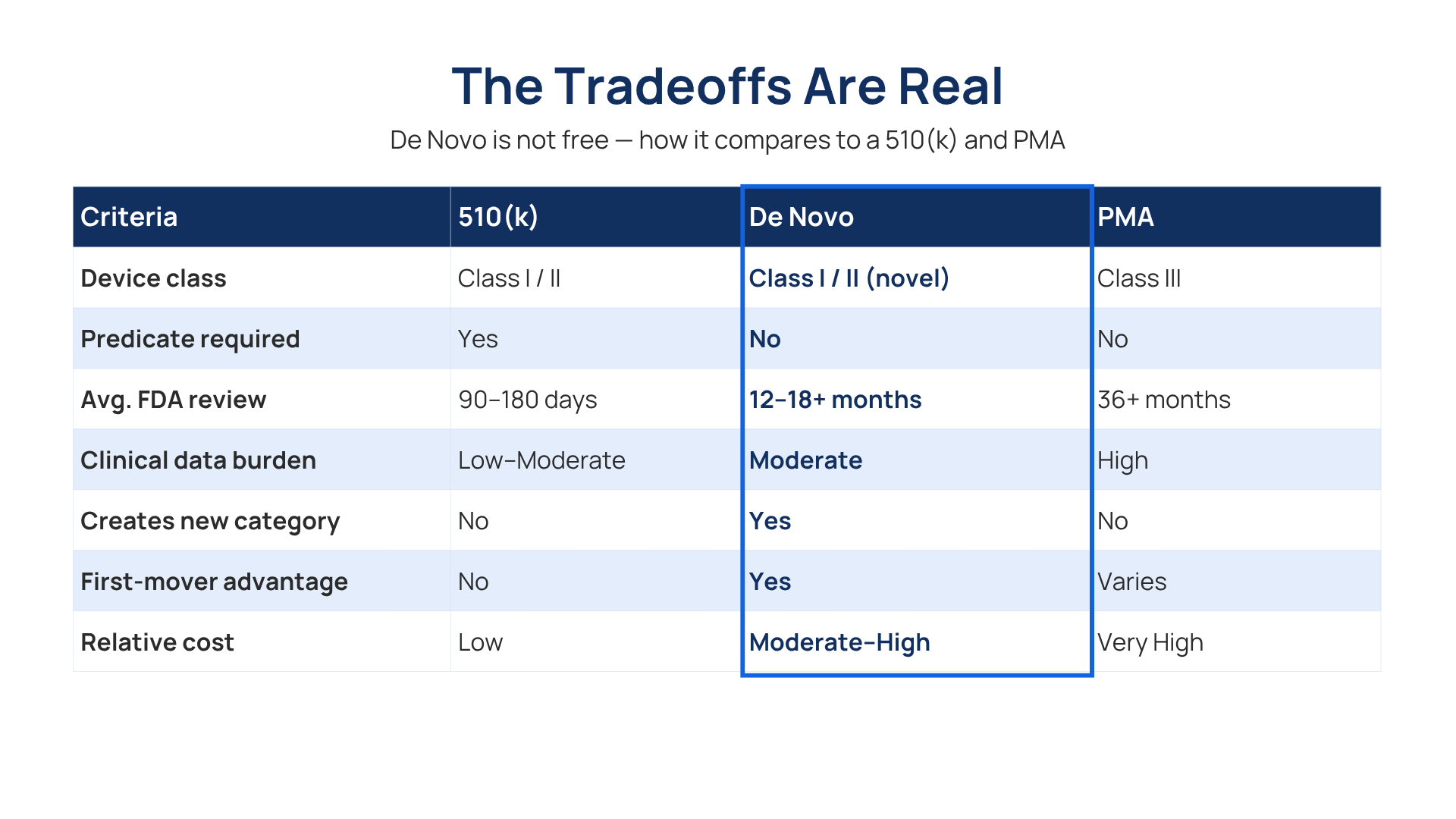
The De Novo tradeoff in one view: you give up the 510(k)'s speed and predictability to gain the one thing neither alternative offers — a category you own.
Plan for 12–18 months minimum, a higher resource burden for Special Controls development and testing, and less precedent to lean on — no predicate means no roadmap. And the Special Controls you define will also bind your own future product iterations, so they must be designed with your roadmap in mind, not just your first device.
When De Novo is the right call
Based on our submission experience and FDA performance data, De Novo is the right choice when three conditions are met:
The device is genuinely novel — no defensible predicate exists.
The risk profile supports Class II — your justification is airtight, referencing similar marketed devices, adverse event data, and the adequacy of proposed Special Controls.
You have strategic intent to own the category you're creating — not just to get to market.
It's the wrong call when speed-to-market is the binding constraint, when validation resources are thin, or when a credible 510(k) predicate exists that would actually survive scrutiny. In those cases, a well-constructed 510(k) remains the superior option — it's still the workhorse of medtech innovation for a reason.
The single biggest predictor of success
Early Pre-Submission engagement. Request a Pre-Sub meeting before investing in validation studies — FDA feedback on classification intent and testing requirements frequently changes the entire strategy. Gaps in validation data are the leading cause of De Novo delays and refusals, and most of those gaps were avoidable with early alignment.
That's the principle behind everything we do: Talk to the FDA, before you talk to the FDA.™
Get the Full Decision Framework
This post covers the highlights. The complete white paper — Navigating the FDA De Novo Pathway: A Strategic Analysis of Pros, Cons, and Decision Criteria for Medical Device Companies — includes the full pros-and-cons assessment, all five critical success factors, and the complete pathway comparison.
Download the White Paper
Evaluating whether De Novo is right for your device? Schedule a strategic consultation before any submission decisions are made.