
Breakthrough Device Reimbursement in 2026: Acceleration or Restriction? The Policy Paradox Deepens.

The Same Day, Two Opposite Signals
On April 23, 2026, FDA and CMS jointly announced the new RAPID Coverage Pathway, a mechanism designed to shrink the time between FDA authorization and Medicare coverage to as little as two months. RAPID promises early engagement, aligned evidence expectations, and a more predictable glidepath to coverage for certain Breakthrough-Designated Devices (BDDs).
But on the very same day, CMS advanced a proposal that moves sharply in the opposite direction.

Hidden within the FY2027 IPPS proposed rule is CMS’s plan to repeal the NTAP Alternative Pathway beginning FY2028 — a pathway that has been central to hospital adoption of breakthrough technologies since 2020.
“CMS characterized breakthrough designation as insufficient evidence of the clinical improvement standard that NTAP is intended to reward.” — FY2027 IPPS Proposed Rule
The result is a policy environment that accelerates with one hand and restricts with the other.
RAPID Coverage: A New Acceleration Pathway
RAPID is intended to align FDA and CMS earlier in the development process. As your document notes, eligibility requires that a device be in an IDE study enrolling Medicare beneficiaries and measuring outcomes agreed upon by both agencies.
Key features include:
Coverage in as little as 2 months after FDA authorization
Early CMS engagement to define Medicare-relevant outcomes
Pause on new TCET nominations while RAPID is implemented
Focus on Class II and III BDDs, plus some TAP devices
RAPID is the clearest signal yet that CMS wants to reduce the 5.7‑year average delay between FDA authorization and Medicare coverage — a delay highlighted in your document via the Stanford Biodesign study.
NTAP Alternative Pathway Repeal: A New Restriction
Since 2020, BDDs have been able to qualify for New Technology Add-on Payments (NTAP) using Breakthrough designation as a proxy for CMS’s Substantial Clinical Improvement (SCI) standard. This has been essential for hospital adoption, especially for high‑cost technologies.
CMS now proposes to eliminate that flexibility.
Beginning FY2028, all BDDs would need to independently meet the full SCI standard — the same evidentiary bar applied to non‑breakthrough devices.
Your document summarizes the shift clearly:
“Beginning FY2028, the alternative pathway would be repealed… all breakthrough-designated devices seeking NTAP would be required to independently satisfy all three traditional NTAP criteria.”
This includes:
Newness
Cost inadequacy
Substantial Clinical Improvement (SCI)
A parallel repeal is proposed for OPPS device pass‑through payments, meaning outpatient technologies face the same evidentiary escalation.
The Broader Landscape: Legislative Momentum, Structural Gaps

Congress is attempting to legislate around these gaps:
H.R. 5343 / S. 1717 would create a four‑year transitional coverage period beginning at FDA authorization.
The Health Tech Investment Act would create a coding pathway for AI-enabled devices.
The MCED Screening Coverage Act would establish a dedicated pathway for multi-cancer early detection tests.
But none of these bills have cleared the Senate.
Meanwhile, structural gaps persist:
TCET remains capped at 3–5 devices per year.
Diagnostics and IVDs lacking a benefit category remain disadvantaged.
AI-enabled devices still face a coding and payment gap.
Commercial payers continue to lag CMS, adding further delays.
The Policy Paradox: Acceleration vs. Restriction
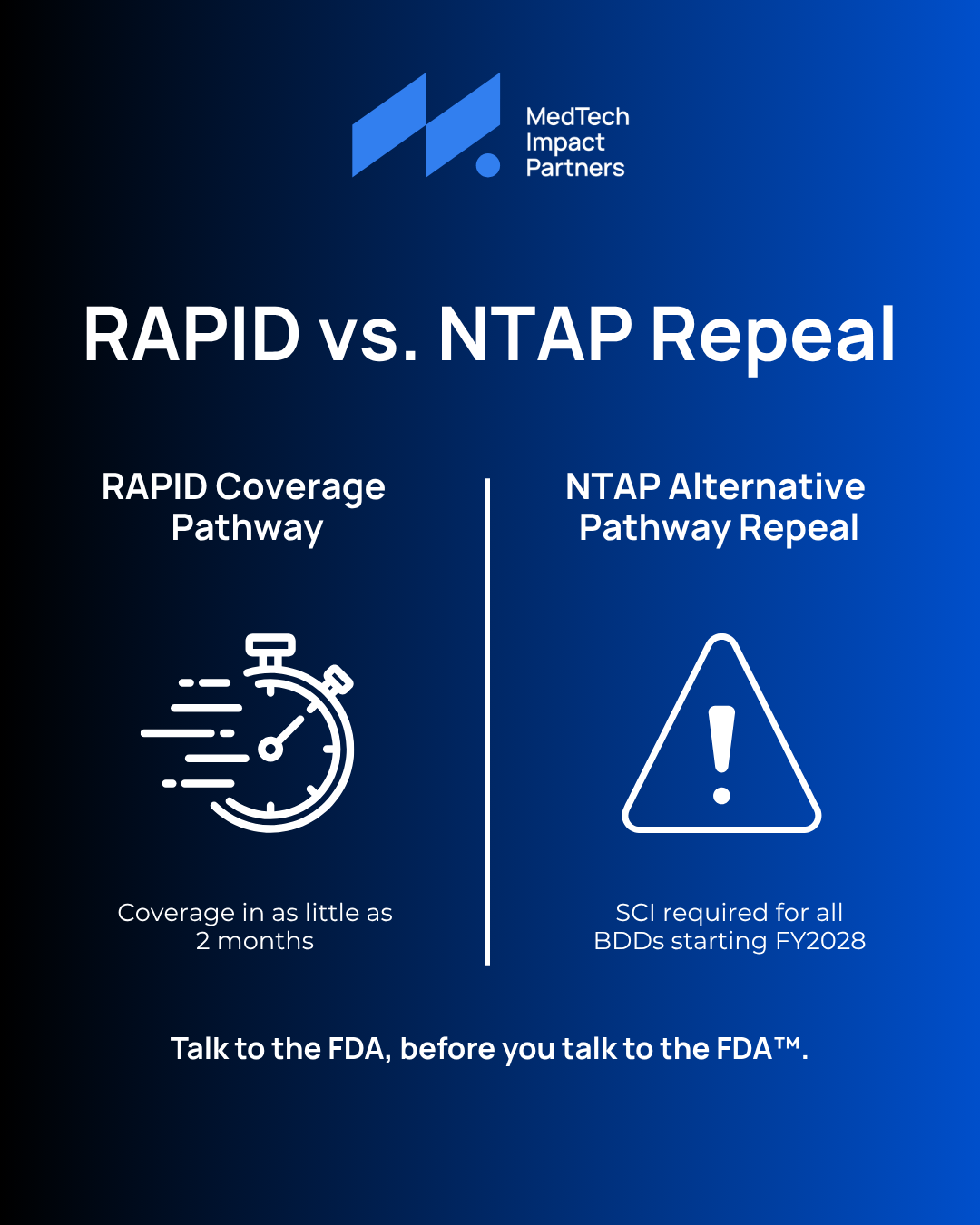
The contradiction is now explicit:
RAPID Coverage → Acceleration, predictability, early alignment
NTAP Repeal → Restriction, higher evidence bar, delayed payment support
For innovators, this is not theoretical. It directly affects:
Evidence planning
Trial design
Coding strategy
Hospital adoption
Capital allocation
Commercial timelines
The regulatory strategy that worked in 2024 will not work in 2027.
What MedTech Innovators Should Do Now
Plan for dual evidence expectations — FDA’s breakthrough flexibility does not satisfy CMS’s SCI standard.
Engage CMS earlier — RAPID makes early alignment possible, but only if manufacturers participate.
Prepare for NTAP evidentiary escalation — SCI-level evidence will be required for FY2028 applications.
Monitor legislative movement — H.R. 5343 could reshape the landscape overnight.
Reassess commercialization timelines — RAPID may shorten them; NTAP repeal may lengthen them.
MedTech Impact Partners is tracking every nuance of this evolving environment.
Talk to the FDA, before you talk to the FDA™.